You Keep Buying Wider Shoes. But the Toe Keeps Bending Anyway.
You know exactly which pair rubs that raised knuckle. You have loosened the laces and decided the shoe was the problem. If the toe still moves when you press it gently, there is a simpler step worth trying first.
Try It Risk-Free for 30 Days30-day money-back guarantee · Free US shipping
You Have Already Made a Plan. You Just Have Not Said It Out Loud.
None of these are quotes from customers. They are the things people quietly tell themselves about a toe that has started to bend. See how many you recognise.
- “I will just buy a wider pair.”
- “It is not bad enough to do anything about yet.”
- “I can still move it, so it cannot be that serious.”
- “Maybe I will deal with it after the holidays.”
- “If it gets bad enough, I will get it fixed.”
If you recognised three or more, you are not being careless. You are doing what almost everybody does. It is just worth knowing what quietly changes while you wait.
There Is One Question You Have Not Said Out Loud.
It is not “does this hurt”. Most days it does not, much. That is exactly why it is so easy to leave alone.
The question that keeps coming back is quieter, and it usually arrives late in the evening with the shoes off.
“What happens if I just leave it?”
Nobody answers it, because answering it means doing something about it. So you put on the pair that hurts least and get on with the week. Another month goes. Another wide fit arrives and does not fix it either.
Here is the honest answer, and it is smaller than you are expecting. Whether you can live with it today is not the useful question. The useful question is whether the toe still moves.
The Only Difference That Really Matters Is Whether It Still Moves.
A bending toe does not go from fine to fixed overnight. It passes through stages, quietly, and the stage you are in decides what is still available to you.
It moves easily
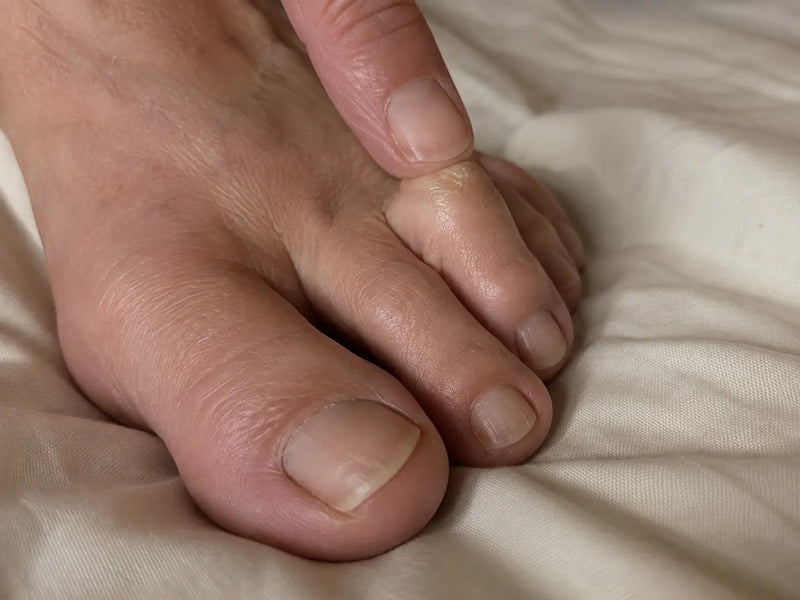
Press the raised knuckle with one finger and the toe flattens without much resistance, then springs back when you let go. This is the stage where the simple measures are still on the table.
It moves, but it argues
It still flattens, but it pushes back and it does not want to stay there. Most people are somewhere around here by the time they start looking for answers, and most of them never noticed it change.
It barely moves at all
The joint has stiffened and will not flatten however gently you press. Per AAOS, a fixed toe requires surgery. A support can still cushion it and take the rubbing off the top, but it will not reposition a joint that has locked.
Try This With Your Toe Right Now.
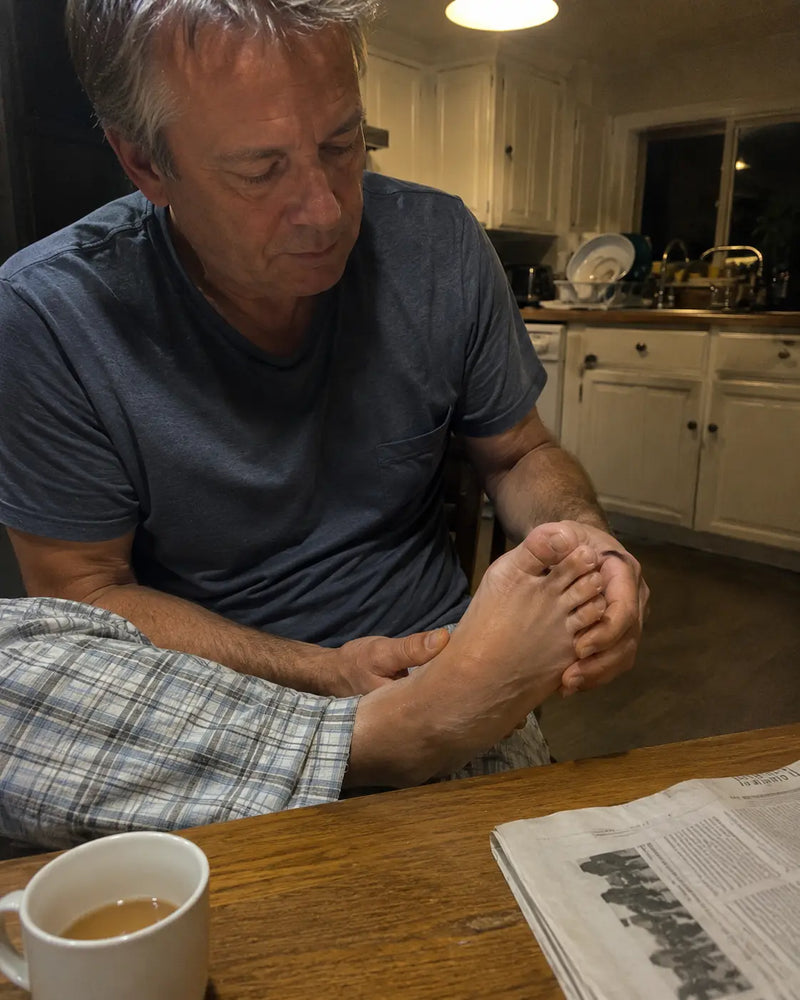
Sit down and take the shoe and sock off. Rest the foot on the floor, or across your other knee, whichever is easier to reach.
Put one finger on top of the raised knuckle. Press the toe gently down toward the floor. Do not force it.
Does it still move?
If it flattens at all, even if it springs straight back the second you let go, you are in the stage where a support can still do something for you.
If it will not move at all, that is a conversation for a foot specialist rather than a website. We would rather tell you that than sell you something.
The Three Ways People Postpone the Decision
None of these are silly. Every one of them is what a reasonable person tries first. The trouble is that two of them buy comfort without buying time, and the third buys nothing at all.
Another wider pair
You know exactly which pair rubs that knuckle, and you have probably loosened the laces before deciding the shoe simply was not going to work. A wider toe box means less rubbing, and less rubbing is worth paying for. But a wider shoe changes the space around the toe. It does not change what the toe is doing inside it. Most people learn this one expensive pair at a time.
Pads, gel sleeves and tape
These cushion, and that is real relief on the days it catches. What they cannot do is hold a toe in a position. Gel pads slide out the moment you pull a sock on. Tape lasts about an hour and you can never get the tension the same twice. Cushioning a toe and supporting a toe are two different jobs.
Waiting until it is bad enough
This is the one that feels like nothing, which is exactly why it is the one that costs. Some days it is annoying. Other days you barely notice. So the decision keeps sliding. Per AAOS, a flexible toe left untreated can become fixed. Waiting does not hold your options open. It quietly spends them.
Hold Here. Gently Lift Here.
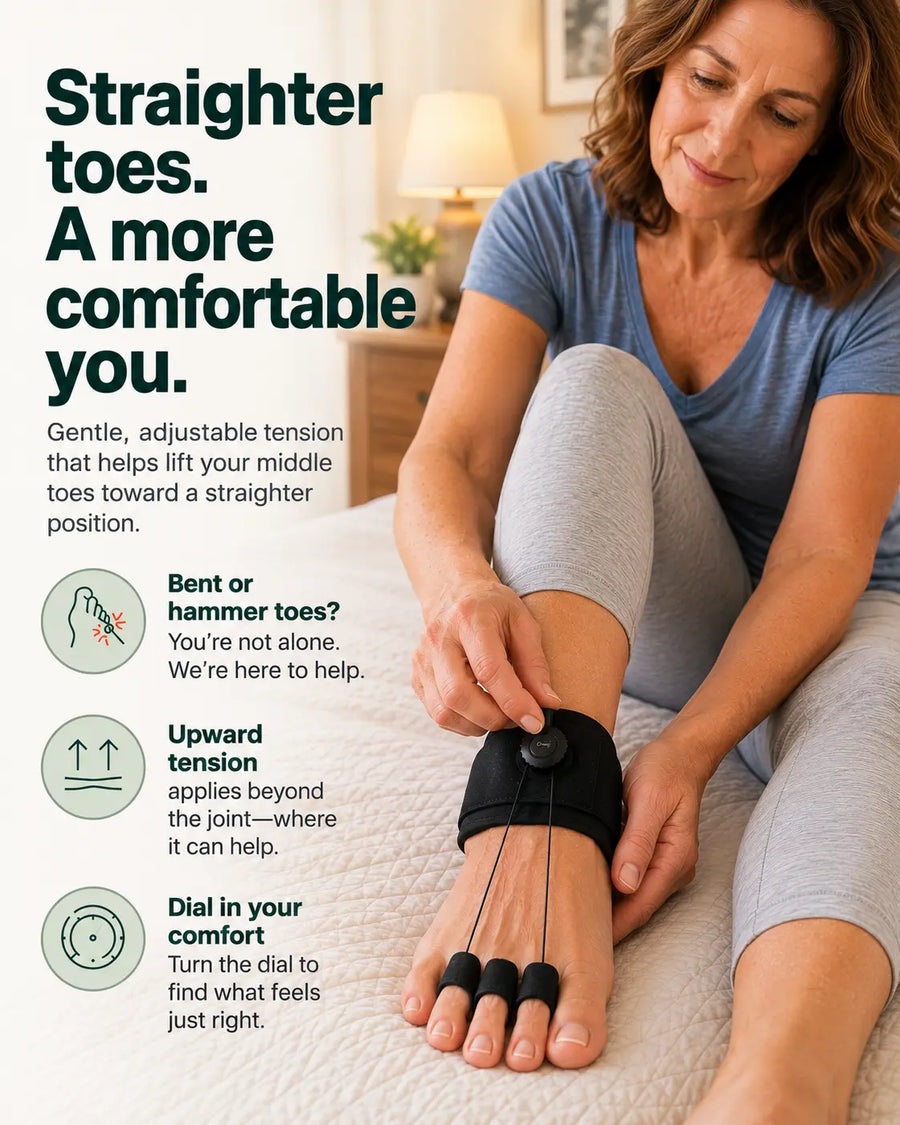
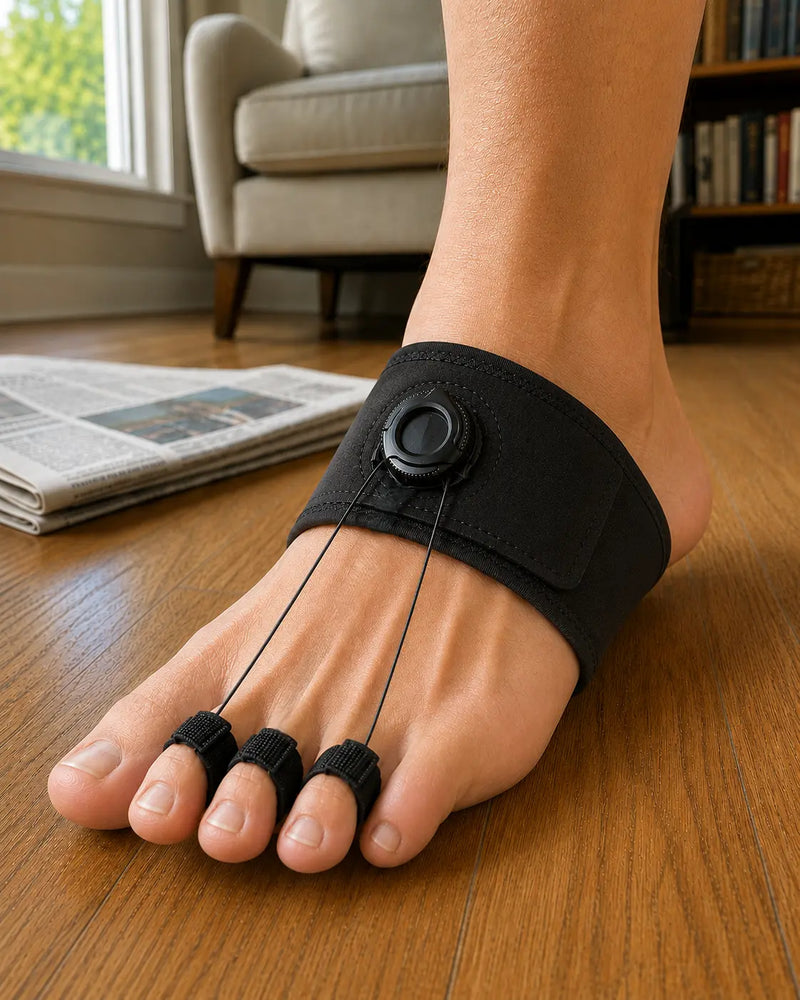
The soft band anchors around your midfoot. Not on the toes. That is the whole reason it does not slide forward and off the way a gel pad does.
Turn the dial and the cords take up tension, one click at a time. Three soft loops sit over the three middle toes. The big toe and the little toe stay bare.
You decide how much tension feels comfortable. Looser in the morning while you are getting going. A click firmer in the evening while you are sitting down.
It does not force the toe flat. It gives adjustable support while you are wearing it, and the moment you take it off your foot is exactly as it was.
If It Still Moves, You Still Have Something to Work With
Pick how many toes need support. Try it for 30 days. If your feet are not more comfortable, send it back for a full refund.
Free US shipping · 30-day guarantee · Delivery typically 5 to 8 business days
What You Are Actually Buying
You can undo it
This is the whole point. Take it off and your foot is exactly as it was this morning. There is no version of trying this that you cannot walk back.
It stays where you put it
The most common complaint we hear about toe correctors is that they slide off. The band anchors around the midfoot, which is designed to reduce that, so it moves when your foot moves and is still there at the end of the day.
You set the hold, not a factory
Turn the dial for a gentler or firmer hold. One hand, sitting down, in a few seconds, any time of day. Snug, never forced.
It goes in the shoes you own
Low-profile, so it fits inside the everyday shoes already in your closet rather than costing you another pair.
Easier Than Putting On a Sock
Slip it on
Place the soft band over your foot and rest the loops over the three middle toes.
Turn the dial
Turn until you feel a gentle, comfortable hold. Never force it. Snug, never tight.
Start small
Begin with 15 to 20 minutes a day and build up. Consistency over weeks matters more than cranking the dial.
Live your day
Wear it reading, cooking or standing at the counter, and adjust it any time with one hand.
What People Say About the Other Road
Real comments from members of Mayo Clinic Connect, a public patient community, about hammer toe surgery. They are not StepRevive customers and have not used ToeAlign Pro.
- “I have hammer toes. I don't know anyone with a successful outcome for hammer toe surgery. Often the hammer toes return”gocy, shared on Mayo Clinic Connect, June 2023
- “the Dr tried to fix one by removing the knuckle in the hammertoe (it doesn't bend now). But that little shortened toe tries to stick up and cross anyway!”marylouc, shared on Mayo Clinic Connect, June 2023
- “I'm 2 years out from surgery and am pleased with the results...I would do it again.”Debbie, shared on Mayo Clinic Connect, August 2025
Plenty of people have a good outcome and are glad they had it done. If your doctor has recommended surgery, listen to your doctor and not to a website. It is simply worth knowing what the operation involves before you decide to wait for one.
What the Operation Actually Involves
The standard correction for a rigid bent toe is called arthrodesis. The surgeon removes a small amount of bone from the bent joint, then holds the toe straight with a pin or a plate while the two bones grow together into one.
AAOS notes you may have some stiffness, swelling and redness for up to four to six weeks. Then, in their own words, your toe “may be slightly longer or shorter than it was before and will not be able to bend at the fused joint.”
That last part is worth sitting with. The joint is not repaired. It is taken out of service. That is the intended result rather than a complication, and it is not reversible.
Hammer toe correction by arthrodesis. Procedure and recovery described per AAOS OrthoInfo.
You Do Not Have to Take Our Word for Any of It.
The quotations below are from published orthopaedic sources, in their own words. They describe hammer toe in general, not your foot and not your likely outcome.
Initially, hammer toes are flexible and can be corrected with simple measures; however, if left untreated, they can become fixed and require surgery.
Once healed, your toe may be slightly longer or shorter than it was before and will not be able to bend at the fused joint.
Recurrence and revision rates following digital deformity correction remain relatively high, with reported rates up to 10%.
Quoted verbatim from published guidance about hammer toe in general. Claims about surgery on this page refer to hammer toe. AAOS states it “does not endorse any treatments, procedures, products, or physicians.” Neither source has reviewed or endorsed ToeAlign Pro. Most people who have hammer toe surgery do well and many are glad they had it. Nothing here is a reason to avoid an operation your doctor has recommended. ToeAlign Pro is a comfort and support aid, not a medical device, and is not an alternative to surgery.
The Bigger Decision You May Not Need to Make Today
Surgical correction of a rigid toe
- A fused joint cannot be unfused
- Per AAOS you may have some stiffness, swelling and redness for up to 4 to 6 weeks
- Your toe may end up slightly longer or shorter
- Recurrence and revision reported at up to 10%
- Often the only option once a toe has gone rigid
- The decision is made once
ToeAlign Pro™
- Nothing is removed, fused or shortened
- Wear it at home, starting at 15 to 20 minutes a day
- Your foot is unchanged the moment you take it off
- Supports and cushions flexible toes, and will not straighten or reposition a rigid toe
- Costs less than one pair of the shoes that did not work
- You can stop at any point and lose nothing but the time
Start While It Still Moves
Choose your bundle below. Thirty days to decide, and nothing you cannot undo.
Free US shipping · 30-day guarantee · Delivery typically 5 to 8 business days
What happens if I just leave it alone?
Honestly, for a while, probably not much, and that is the trap. Per AAOS, hammer toes start out flexible and can be helped with simple measures, and if left untreated they can become fixed and require surgery. Nobody can tell you how fast that happens to you. What is worth knowing is that the cheap reversible options are only available while the toe still moves.
How do I know if my toe is still flexible?
Sit down and push the toe flat with your finger. If it moves, even if it springs straight back the moment you let go, that is the flexible stage and that is what this is for. If it will not move at all, a support like this can still cushion it and take the rubbing off the top, but it will not reposition a joint that has locked. That is a conversation for a foot specialist.
If surgery works for most people, why would I not just have it?
You might, and for plenty of people that is the right call. Most people who have hammer toe surgery do well. Two things are worth knowing before you decide to wait for one. First, once a toe has gone rigid the usual correction is a fusion, and per AAOS a fused joint “will not be able to bend” afterwards. That is permanent. Second, per StatPearls, recurrence and revision are reported at up to 10%. Neither of those makes surgery a bad option. They make it a decision worth taking deliberately rather than by default. Talk to your own doctor.
How long until I notice a difference?
You will feel the comfort of a proper hold quite quickly, mostly as less rubbing where your shoe used to catch. Comfort is what this is for. Anyone promising you a different toe by the weekend is not being straight with you.
Will it fit inside my shoes?
It is slim and low-profile, so it fits inside most everyday shoes: sneakers, walking shoes and work shoes. Shoes with a roomy toe box will always be the most comfortable pairing.
I have diabetes or neuropathy. Can I use it?
Please speak with your physician before using any toe support. If you notice numbness, discoloration or increased pain while wearing it, take it off immediately. Your circulation and your safety come first.
What if it does not work for me?
Then it costs you nothing. Every order is covered by a 30-day money-back guarantee. Wear it, adjust it, walk in it, and if you are not more comfortable, send it back for a full refund.
Try It for 30 Days, Risk-Free
Wear it. Adjust it. Walk in it. If you do not feel more comfortable on your feet within 30 days, send it back for a full refund. No forms, no hassle, no hard feelings. It is the one option on this page you can hand back.
Nothing Removed. Nothing Fused. Nothing You Cannot Undo.
One dial. Three middle toes. Tension you choose. Send it back within 30 days if it is not for you.
Free US shipping · 30-day guarantee · Delivery typically 5 to 8 business days
This product is a comfort and support aid, not a medical device, and is not intended to diagnose, treat, cure or prevent any condition. It is not an alternative to surgery and is not a treatment for a rigid or fixed toe deformity. Results vary from person to person. Statements about surgical procedures, recovery and recurrence are quoted from published orthopaedic sources and describe hammer toe in general, not any individual's likely outcome. Community quotations are the personal opinions of members of public patient forums who are not StepRevive customers and have not used this product. If you have diabetes, poor circulation or neuropathy, consult your physician before use. Discontinue use immediately if you experience numbness, discoloration or increased pain, and see a foot specialist if symptoms persist. Always follow the advice of your own doctor regarding surgical decisions.